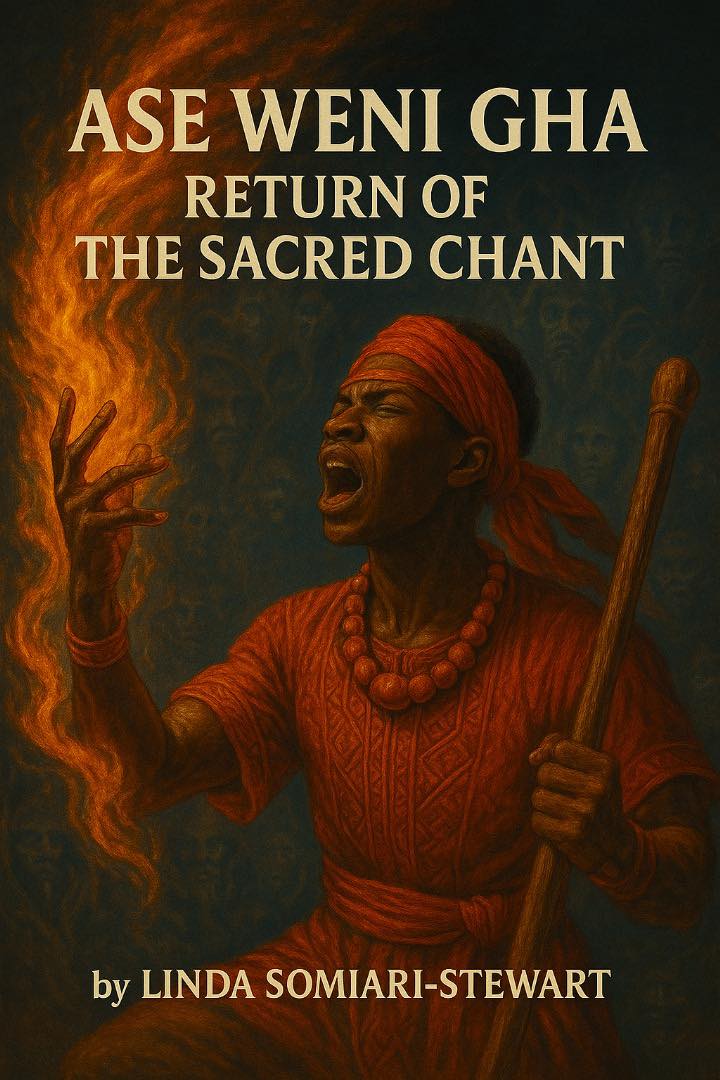
Ase Weni Gha! Return of The Sacred Chant by Linda Somiari- Stewart.
Long before bullets learned our names, before pipelines bled our creeks, there lived a people in a town called Toru-Ebi, a place where the spirits still answered when called.
These inhabitants were warriors, they were keepers of balance, vessels of the ancient warrior-god Egbesu, who gave justice with one hand and demanded order with the other.
Their power was not in their machetes, but in a chant older than salt.
A chant that was a reinforcement of their belief - The Power will not leave us.It was the greatest song of the freeborn.
But as always, shadows creep in when people forget their songs.
The chant became corrupted .
Corrupted to something the gods couldn’t recognize.
The gods of the land saw that the people were speaking to some other entity,for what they were chanting…that was not the chant of the gods.
The chant of the gods, a responsorial chant, had been abandoned.
The people now spoke in an unknown tongue to the gods, and the gods went silent.
The Stuttering Boy and the Day the Drums Died
—————
A boy named Kurobo lived in this ancient coastal town- Toru-Ebi.
Born under the blood moon, his first cry was a stammer, so he remained a stammerer.
The women shook their heads in pity.
The men laughed and mocked.
“This one is no drum,” they said, “He is a broken flute.”
But Kurobo had ears like no other.He heard even the rhythm of crabs burrowing.
He heard the sighs of yam tubers growing in the soil.
He even heard the unspoken grief of his mother whenever she stared too long at his father’s faded First World War medals.
While others made loud noises,Kurobo listened.
And what he heard most clearly was silence. The kind that falls when the gods withdraw.
Then came a day that would change everything.
The silence was shattered.
The invaders came in boats, not the fishing kind, but metal “beasts “ with flags and fire.
They sailed into Toru-Ebi, demanding allegiance,mocking Egbesu, torching shrines,and seizing the sons of the land.
The warriors of Toru Ebi reached for their war drums - Akuma- but the drums did not answer.
The spirits had gone quiet. They chanted their war cry but the spirits did not stir.
There was a loss of connection between the spirits and the warriors!
And the people… afraid,broken.
The Return of the Chant
———————
That night, as fear settled like fog,and the warriors crouched low in darkness, Kurobo the stammerer slipped away to the grove of Oginaba, Temearau-the spirit of creation. In this most sacred groove he crept into the chamber known as the first shrine of Egbesu, and there he wept.
Kurobo stuttered even as he wept beneath at the temple of the great spirit of creation under the silent gaze of his ancestors and the gods in whose charge the great spirit assigned Toru-Ebi.
He knelt, hands trembling, heart beating like thunder.
“Wh..yyy ha- aa- ve yyyoouuuu left us?” he whispered stuttering.
“Whyyyyyy do-do -do the gods flee when eeee - vvviiiillll dances in the land?” he wailed stammering.
His cry was a sincere and bitter one from a broken soul. The kind of cry that breaks barriers between different dimensions and different worlds.
Done crying,Kurobo fell into a deep silence. He listened to the silence as only he could.
He believed his words were caught up in the midnight wind and the wind would respond . He listened intently.
The wind did not answer, but the earth did.
A tremor ran through the soil.
A murmur, low and ancient, rose from beneath his feet.
First, it was a murmur, then he heard it -
“ Teme Ase’ weni?”
“ Teme Ase’ weni gha…”
"Teme Ase’,Amaso wengi
Teme Ase, Amaso wengi so ke"
A second tremor and the chant came again:
Ase’ (shortened version ofTeme Ase ) Weni?
Ase’ weni gha!
It was a chant, a statement, an affirmation, and an invocation. A responsorial chant. A rhythm. A rebirth. A revelation.
Kurobo, dumbfounded, stood up, eyes wide, voice, long mocked, rose like a storm.
“ Ase weni …!” he cried aloud.
The tremor came again with a response “ Ase weni gha !!!”
The murmur continued, repeating the responsorial chant, as if teaching him the proper invocation.
“Ase weni???” The first tremor would come in as a question.
“Ase weni gha!!!” the second tremor would affirm in response.
Amaso wengi so? The first tremor would repeat
Amaso wengi so ke!, the second tremor would respond.
As the chanting continued, the mangroves rustled violently in reply. The river rolled backward and forward. There came a great tempest in all the creeks.
The enemy’s fires blew out, and the invaders retreated in disarray.
Kurobo ran out of the sacred grove, barefoot, into the town square, chanting with a fire no bullet could stop.
One by one, the elders lifted their heads from their weary beds. The warriors came out from their crouching positions.
The women wept and followed Kurobo.
The warriors beat their chests and raised their spears.
Kurobo told the people of Toru-Ebi that they had been speaking to the gods of the land in a strange tongue. They noticed he was no longer stuttering —the gods had touched his tongue! They were awe-stricken.
He taught them the chant he heard from beneath the earth and how to chant it correctly.
He called out, and they responded in chorus, the warriors beating their chests, the elders raising their hands into the air, and the women raising their hands in the air.
As the people chanted, the earth joined in a loud murmur, making the chant echo from hut to hill, hill to mangrove, and from mangrove to the river and to the sea.
The enemy,confused and trembling, became discomfited. Some dropped their guns and raised their arms in surrender. They became prisoners of war. Others fled into the swamp to a certain fate.
And from the shrine of the great spirit a light rose- not flame, but spirit.
Ancient Egbesu had returned! Not in fury, but in balance.
Legacy of the Chant
————
Kurobo never stammered again. The chant of the gods had swallowed his defect.
The villagers renamed him Kurobo–Ase Weni Gha .
He became the Voice of Power.
He taught the correct chant to all who would learn , but always warned:
“This chant is not a weapon for pride but a rhythm of the assurance of the presence of the great spirit of justice.
Ase weni gha!
The great spirit of the nation - Teme Ase- Teme Aso, will never depart from us.
The Great Spirit walks with the humble. If you chant it with a wicked heart, it will echo back against you.”
And so it became part of the rites of passage into adulthood for every freeborn male in Toru-Ebe to learn to speak to the gods in the ancient tongue with an admonition to pass it down to their children.
Soon, everyone learned to speak the ancient language of the gods. They also learned not just to chant correctly, but to listen, not just to the buzz in the air but also to the silence.
“Ase weni???”
“Ase weni gha!!!”
Final Word of the Griot
——————-
So when next you are afraid, when your voice trembles and the world mocks your silence, remember Kurobo.
Speak. Speak the language of your ancestors. It is the language of the spirit.
Learn to speak them correctly even when you struggle or stutter.
Even if your tongue falters, even if your knees shake, speak.
Power is not in your perfection, but in the courage to call out.
The Great Spirit never departs from you, but awaits your call.
When your brother is afraid of the battle, and he turns to you and asks:
“Ase weni?”
Respond to him, saying:
“Ase weni gha." The spirit of the land will not leave us.
Now go home.
And if in your dreams the Akuma drum begins to beat tonight, speak.
The great spirit of creation and the gods are listening again, waiting for the proper call -to -action by the sons of the gods.
Indeed, the great spirit and the gods do not depart; they fall silent when the people forget their tongue and speak to the gods in an unknown language