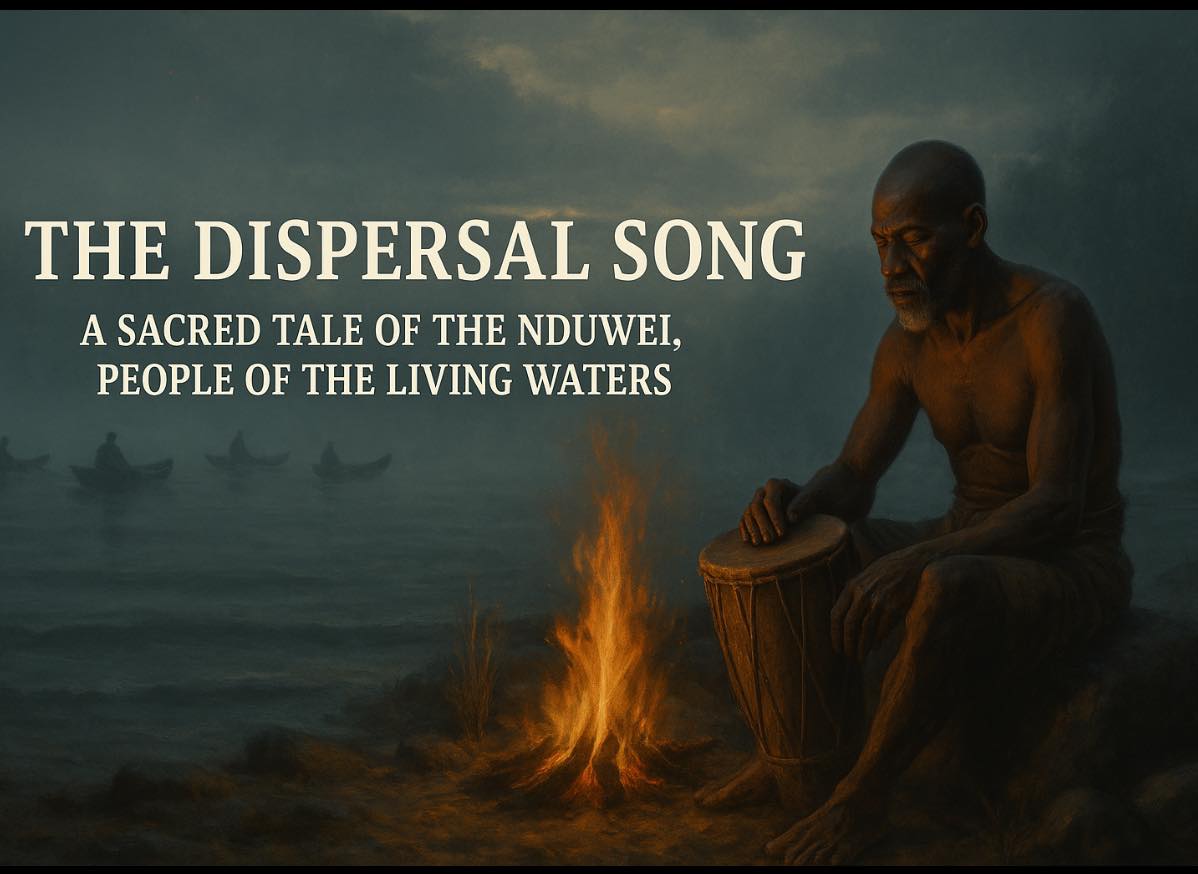
The Dispersal Song by Linda Somiari - Stewart
Sit.
Not too close to the fire, not too far from the dark.
There.
Now listen… for what I will tell you is not just a tale. It is a wound- a wound with a voice.
Long ago, before maps dared name us, we were the Nduwei - the People of the Living Waters.
And when the sea threatened to swallow our names, one voice stood firm. Not a man, not a god—but something between.
His name was Tuburu-Owei:“The Spirit Who Keeps What Must Not Be Forgotten.”
The Song Born
Tuburu-Owei was born in the tide season, when moonlight turns the mangroves silver and the frogs forget to croak.
He came out in silence—but not for lack of breath. No. His first sound was not a cry but a low and full humming like a drum beneath the earth. His mother, Beni-Amatu, called him "my son of echoes."
By the time he could walk, he remembered things no one had taught him:
The names of fallen warriors,
The sea route of the first canoe,
The secret songs of the river crabs.
The elders whispered, “He is not a child. He is a vessel.”
The River's Warning
The tides turned cruel.
Fish swam in circles. Saltwater invaded yam fields.
Children dreamed of drowning while dry.
The great ones gathered at the foot of the Ujo-Kiri baobab:
Ibifa, the shell-reader
Ama-Teni, the midwife who sang in three tongues
Kobaro, the proverb-seer
They summoned the spirits, and the answer came clear as thunder:
“The land grows tired. The people must scatter.
Let memory become a canoe. Let song become a compass.”
The elders prepared for the migration. They packed drums in oilskin. Bound children in raffia.
All would leave—all but one.
The Refusal
Tuburu-Owei stood by the tide rock, his eyes like deepwater.
He spoke:
“I will not go.
If the tree forgets its root, it dies.
I will remain in the soil of our beginning.
I will hold the thread.”
His sister Zowei, no older than the moon, wept.
“Brother, who will remember you if you are gone?”
He placed her palm over his heart.
“When the wind hums and the fire flickers sideways, I will be there.”
The River Spirit
That night, as the village slept in half-packed silence, Tuburu-Owei walked alone into the spirit-swamp, where the air was thick with mosquito and memory. But he did not go seeking peace—he went seeking truth.
There, in the heart of the mangroves where even fireflies did not dare to shine, he met Toburu-Owei, the god whose name he bore—the spirit of Sacred Remembrance, veiled in seaweed, crowned in silence.
The spirit emerged from the black water, clothed in vines and weeping shells, with three mouths—one to speak the past, one the present, and one forever sealed.
“Child of chants,” the spirit said, like dripping stone, “why do you stay when your people flee?”
Tuburu-Owei knelt, pressing his palm to the mud.
“Because it is not the land that betrayed us.
It is we who betrayed the land.”
He spoke of secrets sold for power, of sacred oaths broken in the council of elders.
He told of fishermen who poisoned creeks to outcatch their brothers.
Of daughters sold to strangers in exchange for hollow wealth.
Of tongues sharpened not for truth, but for envy.
He told of the deep, deadly silence that followed every wrong.
The spirit sighed, and the tide around them hissed.
“Yes,” Toburu-Owei said.
“The sea turned because your hearts did.
The river recoiled not from time—but from treachery.”
Then the god unsealed the third mouth, the one that had remained closed since the time before time.
From it came a single sound—low, deep, older than language. It shivered Tuburu-Owei’s bones.
“This is the cost of forgetting. The cost of betrayal.”
“But still,” the spirit said, “not all are lost. One must remember. One must carry the root, even if the branches burn.”
He held out the Gourd of Echoes, a smooth calabash bound in black rope, pulsing with faint whispers.
“Take this. It holds the names, the songs, the shame.
Guard it with your life. Speak when others fall silent.
You are no longer just a griot.
You are the soul that bears the wound.”
And with that, the spirit sank back into the water, leaving Tuburu-Owei alone, gourd in hand, sorrow in heart, memory flooding his bones like tidewater.
The Song That Would Not Die
The Nduwei left at dawn. Canoes slid into the fog.
Only Tuburu-Owei remained.
Alone, he drummed the names.
He fed the memory fires.
He carved the ancestor chants into driftwood and fed them to the sea.
Then, came the storm.
Lightning devoured the shrine.
The river rose, wrathful.
But atop the sacred rock, Tuburu-Owei raised his gourd and sang:
“I am the drum beneath your boat.
I am the name behind your tongue.
I am the story that salt will not erase!”
And when the waves took him, he did not scream. He sang.
The Listening
To this day, when wind passes through hollow wood,
When a child sings a song no one taught them,
When an old woman gasps at a dream full of names she never knew—
That is Tuburu-Owei.
He is the spirit in the tide.
The breath behind the griot.
The keeper of your forgotten blood.
For when you forget who you are,
He will come singing.
“I am the one who stayed.
I am the one who remembers.”